


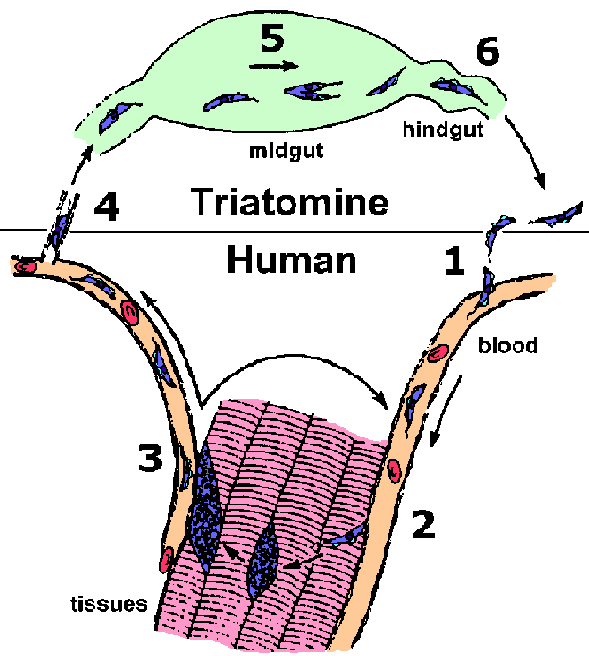


Point of Attack: The Vector Link

Reservoir: Pack Rats
Vector:

Incident Host: Humans
Darth Vadar Transmission
(1a) The first step in our initial efforts to combat Darth Vader will be a survey of the El Paso, Texas, Deming, New Mexico, Hatch, New Mexico, the Ciabola National Forest, Hobbies Mountain Ranch, and the surrounding areas. An emphasis will be placed on areas near rocks, heavy vegetation near hiking trails, and local chicken coops. Carbon Dioxide and Malaise traps will be placed in craggy and wooded areas, and the homes of victims will be investigated around and near the above places. This would provide localized knowledge of where the vectors are present and are coming in contact with the victims. It will also reduce costs that would stem from spraying randomly. A collection will be made of the specimens found, and the locations of Triatoma spp. will be noted for spraying.
-Surveillance Protocol
- Trap Type: Carbon Dioxide Trap (Creekmore 2013).
Materials needed:
~1 cup of water
~1/4 cup of brown sugar
~1 gram of yeast
~1 2-liter bottle
Implementation:
1) Cut the plastic bottle in half.
2) Mix brown sugar with hot water. Let cool. When cold, pour in the bottom half of the bottle.
3) Add the yeast. No need to mix. It creates carbon dioxide, which attracts kissing bugs.
4) Place the funnel part, upside down, into the other half of the bottle, taping them together if desired.
- Trap Type: Malaise Trap (2014).
Materials needed:
~jar
~Solid or evaporating Killing agent
~Net sheet enough to build 3 walls on your trap (for our purposes black mesh)
~ 6 Wooden poles (Five should be 4 ft. and the sixth 5 ft.)
~ A canopy (white)
~ Some rope for extra structural support
~Attractant (heat and carbon dioxide)
a) Carbon dioxide either from sugar and yeast or dry ice
b) heat- thermal blanket to insulate jar
Implementation:
1) locations will be picked based upon victim localization and around known Triatoma recurva habitats
(discussed above)
2) Begin by placing the wooden poles (4 ft. long) in the ground 4 ft. apart for the front and back wall of the trap. The distance of the side walls will be 6 ft. In the center designated back wall the last 4 foot wooden pole will be place, on the opposing side (front wall) we will place the longest wooden pole for the sloping canopy.
3) Use the mesh sheet to make our designated front and back walls, and a wall that runs through the center all the way up to where the collecting jar will be. We will attach the canopy the wooden poles with the sloping end leading up to the tallest pole. As the insects fly up they will funnel their way up into the attached kill/collecting jar at the end of the canopy.
4)To make this trap more efficient in collecting Triatoma recurva, we will an attractant consisting of Carbon Dioxide, which our suspected vector is highly attracted to, so it will make it's way up to the attractant and into the collecting jar for us to test for the agent.
5) A battery operated thermal blanket will wrap around the jar as a means to apply heat. This is also an attractant to Triatoma recurva.
(2) If Triatoma recurva is found, the location will be sprayed with pyrethroid spray immediately. This spray has low toxicity in mammals and birds, is fast-acting, and is known to be effective as an insecticide in small quantities (2014). It also binds very well to organic matter and soil, so that it won't easily wear away with time (2014). Kissing bugs have an incomplete life cycle meaning they do not pupate. This is fantastic for our purposes because most often this is the phase that insects are most resiliant. It is also important to note that all nymphal stages of Tritoma recurva blood feed, which means that they could vector Darth Vader anytime after their first nymphal stage. If another specimen of Tritoma is recovered, it will be tested for Darth Vader as a means to confirm that there is not another vector available to Darth Vader. If another vector is found, it will be investigated in the same way as Tritoma recurva.
-Spraying Protocal:
- Materials:
~pyrethroid spray (allethrin and permethrin- approved to be the safest for humans (2014).)
~air sprayer/ air plane
~hand sprayer/ pump
~ man power and protective gear
*** Precaution will be set to make sure that the spray is not directly applied to water, for it may cause some adverse effects in fish (2014).
- Methods:
~pyrethroid spray will be sprayed over large areas indicated to harbor Darth Vadar via aerial means; this would include areas of known pack rat habitation and forest edges
~professional fumigators will be called upon to spray basements and cellars of indicated areas as well as dog houses and chicken coops
a) fill sprayer with pyrethroid spray
b) direct sprayer at Triatoma recurva infested area
c) apply spray
- Locations:
~those indicated by the surveillance results
~Ciabola National Forest
~Hobbies Mountain Ranch
~ outside of houses in high risk areas (next to woods/cliffs ect)
*** It should be noted that after several applications of pyrethroid spray, a different insecticide, such as a synergist like MGK- 264 or piperonyl butoxide, would be used as a method of preventing vector resiliance. Initially though, pyrethroid spray should be efficient (2013).
- Surveillance of Potential Vectors: Testing Protocol
Samples of bacteria found in Triatoma spp. will be sent to a lab for pyrosquencing.
(1b) Simultaneously, educational propaganda will be constructed to promote public awareness. This would include cooperation from news stations, papers, and radio. The information provided would inform the public on what Tritoma recurva is, what it looks like, and what its bite looks like. Furthermore it will encourage people not to go on early morning or late night hikes or other ventures into or around the forest. It would then incite the public to seek immediate medical attention if they have a kissing bug bite and exhibit any of these symptoms. Below are some images and examples that will be provided to the public:
Triatoma recurva appearance:
Minus the mustache and red eyes.....
Triatoma Bite:
They are generally found around the neck, face, ankles, and wrists, and often occur at dawn, during the night, or at dusk. They look like the below:
If you are bit and exhibit any of the following symptoms please notify the doctor and the CDC:
1)Pain that is worse than would be expected from the appearance of the cut or abrasion.
2)Redness and warmth around the wound, though symptoms can begin at other areas of the body.
3)Flu-like symptoms such as diarrhea, nausea, fever, dizziness, weakness, and general malaise.
4) Intense thirst due to dehydration.
The rationale behind this, is that although there is only one known survivor of Darth Vader, no one has been admitted to the hospital during the earlier stages of Luke Syndrome. There is not a known cure, and supportive treatment is the best hospitals have been able to provide. It is possible that early detection may change this, but this is inconclusive. It is also aimed to reduce Triatoma recurva- human interaction, thus reducing the number of incidences of Darth Vader in humans.
(1c) In order to effectively reduce the interaction between humans and Triatoma recurva, and reduce the spread of Luke's Syndrome, it is important that some household precautions be exercised. Suggestions include:
-
Making sure that all cracks and openings which bugs can utilize to get into the home is sealed as completely as possible, using weather stripping, caulk, or silicone seal.
-
All windows and vents should be properly screened
-
Dog and cat entrances insect proofed
-
Unused fireplace flues kept shut
-
Lights should be moved away from door or windows where they may attract insects
-
An outside perimeter treatment using a broad spectrum insecticide should be applied. In addition, an interior crack and cervice application of insecticide should be made in bedrroms and bathrooms
-
During the active season of kissing bugs, homeowners should throughly inspect their homes for bugs both outside and inside. During the day, kissing bugs will hide in dark, sheltered places, and emerge at night.
-
Inside the home, homeowners should vacuum the bedroom thouroughly and shake out bedding before going to bed. Sticky trap monitors placed under and around beds will often catch wandering bugs.
In order to effectively monitor the success of each approach discussed in our vector plan, our team will be in contact with local wildlife officials, hospitals, and CDC centers in both the vector inhabited areas as well as the surrounding locations. By keeping in close contact with each of these described entities, we will be able to safely and efficiently monitor the subsequent growth or reduction of vectors and humans in contact and infected with Escherichia father.
Monitoring the wildlife officials will include weekly meetings with park rangers and wildlife control officers to discuss the effectiveness of our traps in place as well as the level of receptiveness the public has to the vector education protocol in place. This first line of defense against Darth Vader will provide the foundation for future traps and surveying expeditions which will help limit the overall growth and potential for a large scale outbreak amongst the public.
Contact with the hospitals will include case by case conferences involving patients who may have come into contact with Darth Vader as well as establishing a protocol for a large scale outbreak as seen recently with the Ebola virus in the United States. The quarterly results from the hospital regarding potential outbreaks will be a strong indicator to the effectiveness of our plan in controlling the vector.
Contact with the CDC centers in the surrounding areas will be key to establishing a long term plan for the potential eradication of Darth Vader as well as discovering potential means for treating the disease. Potential cases seen in the hospital will have tissue samples sent to the CDC for further examination and classification (Van der berg and Takken 2009).
Throughout history one can observe the cyclical nature of the spread of disease, claiming literally millions of human casualties. For example the bubonic plague in the middle ages which was transmitted by fleas, similar to our case, was carried by infected rats. It is diseases like the bubonic plague and Darth Vader that get transmitted by insects from reservoir to, in this case, the incidental host that it is referred to as a vector-borne disease. That is the imperative aspect of the cycle our plan of attack targets, the vector, to control the disease if not eradicate it. How successful will be be? Simply by our awareness campaigns we will be able to take the population at risk at this point in time and provide them with essential knowledge of the vector. This will entice the public to avoid the time and locations the vector is active, preventing any contact at any certain point in space and time. We expect this to reasonably reduce the amount of cases reported in hospitals. That, however, still leaves some room for the vector to exploit other opportunities such as people's homes. That is why we have implemented in our plan insecticides in the vector's natural habitats and at people's homes. We can expect notable decline in the vector population which will be directly proportional to the number of newly infected. However this will not be enough to eradicate the vector, this only means that the vector is under heavy selective pressure and once those that are resistant to the insecticide are the only ones left we can expect a boom in the population of the vector. To circumvent that, we included the use of multiple pesticides to be used at different intervals. It is much more unlikely that multiple genes to express resistance to both insecticides will be present in any single vector at any given time. While one insecticide is in use, the other will not be, this will hopefully cause the attenuation of the resistance present in some vectors for the resistance of the previously used insecticide. Finally, with the surveying of the Triatoma population we can monitor any any given time whether or not the pathogen is being carried in T. recurva or any other Triatoma species. We expect to see a drastic drop in reported cases of Darth Vader, but we are also realistic and do not expect the vector to be eradicated but well maintained under control and low numbers. Along with public awareness we can prevent any contact of any vectors left with humans.
Introduction
Escherichia father, commonly known as Darth Vader, in its natural life cycle is transmitted from its reservoir, pack rats, to Triatoma recurva and back again. Humans are an incidental host of Escherichia father, only occuring in humans when they come in contact with Triatoma recurva. In fact human contact with Triatoma recurva is not terribly common on a day to day basis and is generally confined to the hours before dawn and after dusk. Most often contact occurs in nature, and Triatoma recurva does not often invade homes, although they are known to live in dog houses or chicken coops.
As an incidental host, the human body is destroyed as Darth Vader causes a deep tissue infection, triggering Luke Syndrome. The survival rate of an Darth Vader infection is essentially zero. There is no known treatment for Luke Syndrome and there is no known antibacterial used to combat Darth Vader. Essentially once infected, there is nothing a hospital can do to increase your odds of survival other than supportive treatment.
The reservoir, pack rats, live almost anywhere dark; including forests; under thick vegetation; in cellars; and under houses . They do not generally come out during the day unless their nests have been disturbed and thus do not often come in contact with humans. It is not known if the disease can be directly transmitted from the pack rat to the human, and although that is yet to be examined, it is the general case for the vector, Triatoma recurva, to be necessary in the transmission of Darth Vader to humans.
After consideration of the interactions of Darth Vader with its vector, its reservoir, and humans and the interactions of these groups with one another, it was decided that the link between Triatoma recurva (vector) and humans (incidental host) would be the best starting point in the interuption of Darth Vader's infection of humans. This was primarily decided due to the fact that no medical headway is guarenteed and that the prevention of illness seems to be more justified than attempting to combat the illness from within the body. Essentially it was reasoned that the scope of impact would be lessoned if prevention was focused on initially.
Because there is little interaction between the reservoir and humans, and there is no evidence to suggest that the reservoir can directly infect humans, the link between vector and human is the target of initial treatment. This plan involves a survey, testing of related Triatoma spp. for potential vector capabilities, pesticide use in localized and known Triatoma recurva habitats, public awarness, and education campaigns. Hopefully this plan, will reduce human-Triatoma recurva interactions, thus reducing the number of people infected by Darth Vader, ultimately reducing the quantity of human deaths and the number of people impacted by the disease.

Link of Initial Interest: The first step in our plan of Darth Vader prevention is to decrease human Triatoma recurva interaction.

Please click on any of the green buttons to learn more about each host's relation to Escherichia father and its importance to this epidemiology investigation. The knowledge of the links between these hosts are discussed below.
ESTIMATED COST: ~ $400 per trap
ESTIMATED COST: ~ $10.00 per trap


Creekmore, M. D. 2013. A Homemade Mosquito Trap that Really Works. (http://www.thesurvivalistblog.net/homemade-mosquito-trap/)
Mississippi Entomological Museum. 2014. Malaise Trap (http://mississippientomologicalmuseum.org.msstate.edu/collecting.preparation.methods/Malaise.traps.
html)
(TAMUAE) Texas A&M AgriLife Extension. 2014. Insects in the City. TAMUAE, College Station, TX.
(USDA) U.S. Department of Agriculture. 1986. Collecting and Preserving Insects and Mites. USDA, Washington D.C.
(USEPA) U.S. Environmental Protection Agency. 2013. Pyrethroids and Pyrethrins. USEPA, Washington, D.C.
Van der Berg, H., and W. Takken. 2009. Evaluation of Integrated Vector Management. Cell. 25: 71-75.
References
Monitoring Success
Conclusion


They live under brush, thick vegetation, in rocks, basements, chicken coops, dog houses, and are often associated with pack rat habitats. Avoid them if seen. Call pest control. For more information that could be released about this vector and its habits, please click the button below.


<- We want to prevent this.