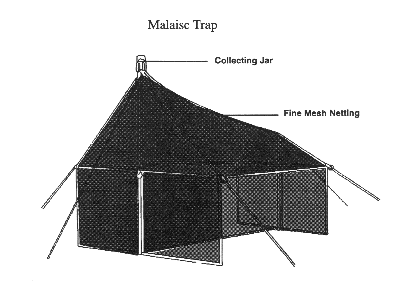
Malaise Trap
Brief Overview
A simple trap developed by the Swedish Entomologist René Malaise that works great in catching flying insects (Schauff 1986). It's original design involves a vertical net to serve as a baffle leading up to a sloping canopy to where the insects will fall into the collecting device. There are a few variations to this trap which include but are not limited to unidirectional or bidirectional designs and increasing it's efficiency by using attractants. This trap has be widely recognized for its success collecting large number of species.
Materials and Methods
1) Jar
2) Solid or evaporating Killing agent
3) Net sheet enough to build 3 walls on your trap (for our purposes black mesh)
4) 6 Wooden poles (Five should be 4 ft. and the sixth 5 ft.)
5) A canopy (white)
6) Some rope for extra structural support
7) Attractant (depends on the type of insect you want to collect)
First we will strategically chose the location for the traps, considering environments of the insects described by the patients. Once we have found an appropriate location we will begin by placing the wooden poles (4 ft. long) in the ground 4 ft. apart for the front and back wall of the trap. The distance of the side walls will be 6 ft. In the center designated back wall the last 4 foot wooden pole will be place, on the opposing side (front wall) we will place the longest wooden pole for the sloping canopy. We will use the mesh sheet to make our designated front and back walls, and a wall that runs through the center all the way up to where the collecting jar will be. We will attach the canopy the wooden poles with the sloping end leading up to the tallest pole. As the insects fly up they will funnel their way up into the attached kill/collecting jar at the end of the canopy. To make this trap more efficient in collecting our potential vector, which we think is a Hymenopteran, we will an attractant consisting of Carbon Dioxide, which our suspected vector is highly attracted to, and given that at its final instar it develops wings, it will make it's way up to the attractant and into the collecting jar for us to test for the agent. For the sake of our collecting purposes, this trap will be placed in a few locations at Ciabola National Forest and Hobbies Mt. Ranch, places that stood out the most in these cases.
Bibliography
Mississippi Entomological Museum. 2014. Malaise Trap
(USDA) U.S. Department of Agriculture. 1986. Collecting and Preserving Insects and
Mites. USDA, Washington D.C.